


ESP8266 WiFi Shield for Arduino
Description
- Arduino R3 Layout
- 802.11 b/g/n
- Wi-Fi Direct (P2P), soft-AP
- Integrated TCP/IP protocol stack
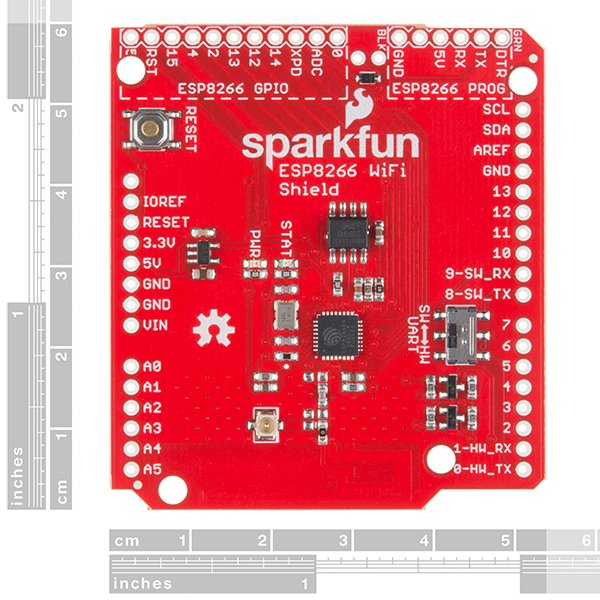
The ESP8266 WiFi Shield for Arduino is an Arduino compatible shield for the ESP8266 WiFi SoC – a leading platform for Internet of Things (IoT) or WiFi-related projects.
Features:
- Integrated TR switch, balun, LNA, power amplifier and matching network
- Integrated PLLs, regulators, DCXO and power management units
- Integrated low power 32-bit CPU could be used as application processor
- +19.5dBm output power in 802.11b mode
ZIP File
After receiving a damaged unit , that has been replaced no charge - Thanks to RobotShop exceptionnal service - I finally hooked up this sucker on mt Uno. 1 - The board programm connector can touch the USB connector , make certain it is isolated (Tape, Hot Glue, etc....) 2- The onboard antenna has no gain so it is disconnecting intermittentli, Best if you use SMA to uFL/u.FL/IPX/IPEX RF Cable Product Code : RB-Ada-108. 3- This unit is connected to the Arduino on either softserial (pins 8-9) or hardware serial (pins 0-1). But the Uno has only one UART, so if your looking to get full speed - wich is oubiously why you use it - you have to hook it on a MEGA or use it on standalone mode. Conclusion: If you want to get in the ESP8266 stuff , better use the standalone product like the ESP8266 Thing Breakout Board or the transceiver modules.
Après avoir reçu un appareil endommagé, celui-ci a été remplacé gratuitement - grâce au service exceptionnel de RobotShop -, j'ai finalement branché cette ventouse sur mt Uno. 1 - Le connecteur de programme de la carte peut toucher le connecteur USB, assurez-vous qu’il est isolé (bande, colle chaude, etc.). 2- L'antenne embarquée n'a pas de gain, elle est donc déconnectée par intermittence. Idéal si vous utilisez un câble RF SMA vers uFL / u.FL / IPX / IPEX. 3- Cet appareil est connecté à l'Arduino via un câble série (broches 8 à 9) ou matériel (broches 0 à 1). Mais l’Uno n’a qu’un seul UART, donc si vous cherchez à atteindre votre vitesse maximale - c’est la raison pour laquelle vous l’utilisez - vous devez l’accrocher à un MEGA ou l’utiliser en mode autonome. Conclusion: si vous souhaitez intégrer la fonction ESP8266, utilisez plutôt un produit autonome, tel que le ESP8266 Thing Breakout Board ou les modules émetteur-récepteur.
Estimate shipping
Refund Policy
If you are not satisfied with a product purchased from the Site, you may request a return within 30 days from the delivery date, unless the product is listed under the Return Exceptions below or is subject to specific return conditions noted on the product page.
This return policy also applies, as a minimum standard, to products sold and fulfilled by third-party vendors through the Marketplace.
Please review the Return Conditions, Return Exceptions and the process on How to Request a Return Authorization (RA) before initiating a return request.
Returns under this policy concern non-defective products. In the case of a confirmed manufacturing defect, remedies are handled under the Warranty terms, at the Vendor's discretion. See the Warranty section.
Return Conditions
To qualify for a refund under the 30-day return policy, all of the following conditions must be met:
- A valid Return Authorization (RA) number must be obtained prior to returning the product. Returns without an RA number will be refused.
- The RA number is valid for 30 days. The returned item must be received within that period.
- The RA number must be included with the return.
- Products must be returned in unused, unmodified condition (e.g., no scratches, alterations, missing parts, or signs of installation/use) and in their original packaging, suitable for resale.
- Shipping fees are non-refundable. Return shipping costs are the responsibility of the customer, except in cases of a product confirmed defective through RobotShop's troubleshooting process or of a verified shipping error by RobotShop.
- Refunds are processed within 7 days after receipt and inspection of the returned item.
- A $100 cleaning fee may apply to domestic robots returned in used or unclean condition.
- A 20% restocking fee may apply to large-quantity returns of items ordered specifically for the customer from the manufacturer or not part of RobotShop's standard inventory.
Return Exceptions
The following products are not eligible for return or refund under this policy:
- Used, damaged, or modified products — Items that show signs of use, wear, or alteration, making them unsuitable for resale.
- Consumables — Use and wear-and-tear components, altered or depleted through use (e.g., batteries, belts, brushes, gears, filament, tires, disposable bags, lubricants, greases, waxes, etc.). Not eligible for return once opened or used.
- Perishables — Goods liable to deteriorate or expire rapidly. Not eligible for return.
- Sealed goods (health or hygiene) — Items sealed for health-protection or hygiene reasons (e.g., masks, gloves, odor-absorbing products). Not eligible for return once unsealed.
- Build-it-yourself products and items requiring customer assembly — Including robots & kits, robot parts, and other products requiring assembly or soldering. Not eligible for return once assembled, soldered, or installed.
- Digital Goods, Software, and Apps — Final sale only, due to licensing restrictions.
- Clearance Items — Products identified as clearance or final sale, including end-of-life or discontinued items.
- Custom-made, personalized, or special-order items — Products manufactured, configured, adapted, or built to the customer's own specifications and requirements.
- On-Demand Items — Standard catalogue products not stocked by RobotShop and ordered specifically to fulfill a customer request.
- Professional & Specialized Equipment — See the Professional & Specialized Equipment Warranty page and Professional & Institutional Buyers (B2B) section in the Terms & Conditions.
How to Request a Return Authorization (RA)
While the same return policy applies, these orders require a separate contact process for returns.
- RobotShop Fulfilled Orders → submit a support ticket from your account under My Support Tickets.
- Marketplace Vendor Orders → submit a ticket from your account under My Marketplace Tickets to contact the vendor directly.
Note: Marketplace vendor products are normally labelled with SKUs starting with RM, and identified on the product page with the mention "Sold and fulfilled by [Vendor Name]".